Saturday, January 12, 2019

A New Adventure/ My December Classroom

Happy New Year!

Something popped into my life at the end of November that fit in easily, and has been thoroughly fulfilling. A local Montessori school had their toddler lead guide leave with a family emergency, and they needed a fill in. They were able to accommodate my son's school schedule, and his school was able to allow him to stay for lunch so that I could be there for the children's entire work cycle. I began at the beginning of December, and made many changes to the environment, and the students adapted beautifully. A month in and new habits are being nicely engrained: spills are regularly being cleaned up, they get their placements out before snack, put their dishes in the bin after snack, and switch to slippers when they arrive.

Here's a look into our December classroom:


As you enter the classroom to your left you will find a shoe shelf and chair to sit in while putting on and taking off shoes and slippers. On the shelf is a shoe horn for those difficult shoes. Next to that is the care of the the environment shelf and the sensory table. At the sensory table for December we were washing a baby.

Left-to-right on the top shelf (too high for student's to reach), is a candle that spins with the heat of the flame, facing towards the parent observation window is three resources for families to check out: "The Joyful Child" by Susan Stephenson, the NAMTA DVD "What is the Montessori Toddler Community?", and "How to Raise an Amazing Child" by Tim Seldin, and and LED candle.


On the care of the environment shelf is (left-to-right):

Top: "I Can Help" book, plant, watering can
Middle: small broom and dustpan, duster, table washing work
Bottom: flower arranging, hammering tees


Next while walking to the left is a ball tracker. This work has four balls: red, blue, yellow, and green. I took the photo while a student was chasing down the errant three balls :-).


Then we will come to the wagon with jugs to place in and pull around. NOTE: I use thick juice jugs rather than milk jugs. They split less easily when dropped.


Next we come to dropping bells into a jug. The younger members of our community can use a palmar grasp, the older members can use the string on the bell ornaments to drop with a thumb-forefinger grasp.


Next we come to drawing on the window with a window crayon and then washing the crayon off of the window. In the caddy is a squeegee, a spray bottle, and a microfiber cloth.
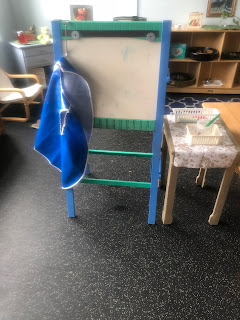
When we turn we come to our art easel. We are currently using a paint brush and long green construction paper (12 x 18) with red paint to make wrapping paper. I only put about half an inch of paint in the cup each morning and refill as necessary during the work cycle. After the work cycle I clean the cup out. To hang the paper I attached a magnet strip to the easel and I use washers. This is easier than clips for the toddlers.


The other side of the art easel is a chalk work. Red and green chalk and a sprayer and sponge to clean (the cleaning is more popular than the drawing!). You can also see our Rainbow Rocker behind the easel.


Beside our window washing is our art and music shelf (left-to-right):

Top: drying rack, Christmas cactus
Middle: dough work, holiday card making (see below for close-ups of both)
Bottom: Jingle Bells book and bells, drum with drumsticks


Both of these art works are open ended. While I make have a goal in my mind, I do not create a model for the children to follow. I also do not tell them it is a gift for their family. I let them create, then I saved it if they wanted to. Not all students made one and it is not required of them.


A wreath ornament from my youngest (19 months old), and my oldest (will be three at the beginning of March). The dough used is Model Magic.


Wrapped and finished gifts with holiday cards attached.

Continuing on around the classroom, this is our Peace/Self-Reflection Corner (left-to-right):

Top: meditation jar, desktop fountain (which has been great for learning self-control and how to watch something with hands behind back and not touch), and lavender filled stuffed frog

Bottom: "Guess How Much I Love You" book and stuffed animal


Next stop the beloved fish tank. Another classroom addition that has been great for teaching self-control and care of living things. Five 25 cent feeder goldfish are in here, saved from being another animal's next meal!


On the science shelf is (left-to-right):

Top: fish feeding, "Let's Have a Pet" book, Golden Pothos cutting, fish book and a stuffed fish for naming parts of the fish
Middle: "Wet Pet, Dry Pet, Your Pet, My Pet" book, fish in water, gluing parts of fish
Bottom: rock exploration (geology), fizzy water (chemistry), Juniper branch (berries removed and placed in a salt shaker for smelling) and pine cones (life science)


Next we come to our calendar. The ornaments we are adding to our tree mimic the bead bars in the casa classrooms. This is an indirect lesson, we are only counting number of days in the month, not each line. We do not have a circle or calendar time, this is a first come first served work and members can also take it apart and reapply as much as they would like.


On the language and math shelf is (left-to-right)

Top: "How the Grinch Stole Christmas" book and stuffed animal (it was being loved when the photo was taken), plant, "Twas the Night Before Christmas" book
Middle: matching photos and objects, Frosty the Snowman (see below for details)
Bottom: ornament for calendar, goldfish matching and sorting (using colored Pepperidge Farm goldfish crackers), matching photos and shapes


matching photos and objects
Frosty the Snowman
matching photos and shapes


Continuing on, is our cooking station. Depending on what is on the menu, we will use a crockpot, fifth burner,or toaster oven. This month we made wassail and hot chocolate in the crockpot.


Our dishwashing stand and laundry hamper below.


Our broom, sweeping guide, and mop for caring for our community. These are in almost constant use!


On the care of the self shelf is (left-to-right):

Top: box with bangles, tissue box, plant
Middle: velcro frame, large button frame
Bottom: brushing teeth, dressing a baby (see below)


brushing teeth
dressing baby


On the care of the environment food prep shelf is (left-to-right):

Top: compost crock, placemats, napkins and silverware
Middle: pouring water, snack item 1
Bottom: snack item 2, making a pomander, bean pouring

Our snack changes daily and we put out the necessary prep and serving materials.


Plates and glasses for snack.


On the sensorimotor shelf is (left-to-right):

Top: rainbow stacker, table work mats, geometric grading puzzle
Middle: geometric lock boxes, disk on horizontal dowel, disk through slot
Bottom: triangle stacker, bead stringing, screw block

Floor work rugs are next to the shelf.


Tree for decorating. Underneath is a recycling bin.


And finally our cubby area.


Bathroom waiting and changing area, and of course, bathroom reading material!


Bathroom cubbies for changing clothes.


Sunday, November 18, 2018

Fall Art for Toddlers


Two things I often encounter in homes and classrooms is a fear of messes and a need for adults to see a cute or pretty product. These two mistakes in parenting and teaching manifest most clearly in art and food prep. Today, let's tackle art.

Art is messy. Childhood is messy. Adults have to be able to allow this. Dr. Montessori knew that children need to have two main things in order to learn at maximum capacity: freedom and experience. When we take away either of these two things, it is difficult for true learning to occur. As adults, our job is to prepare the environment for successful exploration.

When setting up art we want to give them experience in many media (crayons, paint, etc) and many tools (brushes, sponges, nature, etc). Not all media and tools will be a hit with all children, but we cannot find those that our children like if we do not provide the experiences.

For my classroom, I use a very loose theme approach. I use colors and provocations that match what the children are seeing around them. So, in the fall I use oranges, yellows, browns, and reds primarily. These change approximately monthly, depending on student interest. I also use fall to explore the color orange, I generally have a work out that has red and yellow and the children can mix the colors to create orange. Sometimes it is a dough work and sometimes it is a paint work. This is the color mixing work I currently have by my easel. They use the paintbrush at the easel to stir and then then can use the paint at the easel. I have a pumpkin beside the easel as a possible still life inspiration.


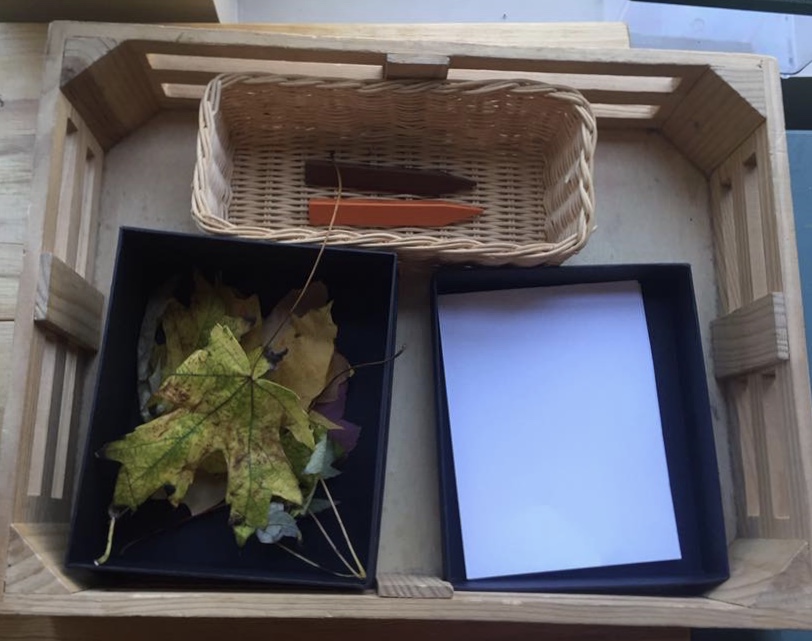
Because Montessori is mixed age, I also make sure that the work can be explored at many different levels. So my youngest could fingerpaint, while the oldest could potentially use a still life provocation. Applying this criteria to the leaf work pictured above, the children could use the leaves to paint with, paint the leaves to create a print, put the leaves on paper and use the brush to paint the edges (shadow paint), or however else they may want to explore the material.

Apple Stamping

You can use a stamp pad or paint with this work. The apple can be also cut longways to see if the print turns out the same or differently. The apple can also be left whole and they can roll it on paper in the tray and leave "apple tracks". Older children tend to stamp with the apples to see the apple shape on the paper. Younger children like to use the apple as a tool to apply the paint, they rub the apple all over the paper.

Dough


One of the differences between art in a Montessori environment and art in a conventional preschool is that we place special emphasis on the mechanics of art. This is not done through instruction; however, it is done through the prepared environment. When we prepare the work, we do so in a way that they are able to hone in on a specific skill. So rather than a tub of dough cutting tools, we narrow this down. This work has 3 tools only: dough scissors, a rolling pin, and a leaf cutter. I put the dough into rolls for the benefit of my youngest children. The dough scissors are the best way that I have found to introduce scissor use. They learn the mechanics of the scissors and the scissors only cut the dough, so it is very safe. The dough is stiff on its own, so the problem that crops up when cutting paper (the limp paper that is difficult to control while cutting), is eliminated. Older children can work the dough, roll it flat, and use the leaf cutter.

Leaf Rubbings

In this work the children can use the crayons (I prefer triangle crayons because they encourage a better grip) to see the veins of the leaves. The leaf is under the paper and the child rubs with either the point or the side. The effect is better with the side, but that is difficult for the younger students as their grip strength is not quite there, yet. Alternatively, they can trace around the leaves, color the edges to create a shadow shape, or use the leaves as still life and draw the leaves.

Cork Stamps

I have a fabulous set of leaf stamps (from Kid Made Modern). They are about a child's full hand size, so they seem to really like them. You could also set this up with paint and a stiff paintbrush, so they would paint the paint onto the stamp and then stamp on the paper. I always try to make sure that I give the language of "maple" and "oak" when they are using these.

Preparing the Environment for Cleanup

This is a key part of the art lessons. The children should be able to mostly clean up after themselves, and we need to make it so that the cleanup is not overwhelming for them, and us! One key component of this is the amount of material provided in a work. Enough paint to do the work, but not so much that a spill would be a disaster. I never leave out all crayons, oil pastels, etc. I just put out a few colors to choose from. We also have a cleanup space in the classroom, so that the children can clean up their own brushes. We do not have a source of running water, so we have a bin with a pitcher. The brushes go in the bin, the child gets a pitcher of water from our water cooler, pours in in the bin, then uses their hands to get the paint out of the brushes. Then the brush is wiped dry with dedicated brush towels (these do become stained, so we have specific washcloths for just this purpose). Then return the brush to the work. Dump the bin water into the waste water bucket, which I empty after class. This does not 100% clean the brushes, so I do need to clean them at the sink with running water after class. But it does make them usable for another student. An apron or the option of removing clothes (honestly what my students prefer) allows for clothes to stay clean and dry.

Don't be afraid of art! In addition to the obvious creativity that comes from art, it also builds hand strength for writing. And, who knows, you could be the inspiration for the next great artist or a life long hobby and love of the arts!


Friday, November 16, 2018

My Own Childhood Handiwork


Handwork is one of many important life skills, what we call Practical Life exercises, that will benefit the child as they grow up. We start as an infant with a threading work, rings on a vertical dowel, and progressively grow the child's sewing ability. In addition to the obvious usefulness of the skill, it strengthens the fingers for writing and other fine motor work and as well as develops concentration, coordination, order, and independence.

A main part of my first Montessori training (3-6) was about examining my own childhood and education as a child. To breakdown our own barriers to optimal education, and then build us into the greatest guides we can be. Through this self-examination I found that much of the way I was raised at home (not my formal education) was very Montessori. I wonder if this was due to my parents specifically, our socioeconomic status (bouncing between poor and very lower middle class), the time I was growing up, or the place I grew up (small city edge of Appalachia). Probably a combination of all of these things. What this meant in practice was that I had what we would now call a "free range" childhood AND I had chores and learned how to take care of my environment very early. Sewing was normalcy in my world. My grandmother sewed many of my clothes as a child, I made Barbie clothes with her. It is interesting to me that this is now an extraordinary thing.

This cross-stitch sampler was one of my first major sewing projects. My mom was an avid cross-stitcher, so she taught me the basics and bought me the pattern and supplies. My dad was a woodworker. He made the frame, but he let me mount my finished sampler. Notice that it isn't framed exactly straight. After my Montessori training, I loved looking back at this and seeing how they guided me, but let me make "mistakes" in my work. How important!

Below is some resources for sewing and weaving. Enjoy!

Infant Threading (Rings on a Vertical Dowel)


https://www.etsy.com/listing/610674225/natural-wooden-rings-on-a-vertical-dowel?gpla=1&gao=1&&utm_source=google&utm_medium=cpc&utm_campaign=shopping_us_c-toys_and_games-toys-learning_and_school&utm_custom1=2c3a1352-78fd-421b-83ed-efa4d87627e8&utm_content=go_304504475_22746218315_78727449275_aud-537409439012:pla-106551513395_c__610674225&gclid=CjwKCAiAz7TfBRAKEiwAz8fKOJTg-6Nmgm3X1KaByJspNI5USSntE15XpSfFbsL60tb_Znd-O_fFvBoCIvQQAvD_BwE

Sewing in the Montessori Classroom


https://www.montessoriservices.com/sewing-in-the-montessori-classroom?q=sewing%20in%20the%20&nsearch=prm_link

The Work of Wool: A Montessori Handwork Album


https://www.montessorihandwork.com/shop-1

Sewing and Weaving Activities


https://www.montessoriservices.com/practical-life/sewing-weaving


Wednesday, November 14, 2018

Veer's Classroom and How We Montessori At Home


Veer, who is 4.5 years old, attends a local Montessori preschool everyday for half a day. I strongly believe that it is in a child's best interest to have a non-parent have a prominent caregiver role in a child's life. Children respond differently to non-parental adults, and they benefit from a broader base of experiences that other adults can provide. They benefit from having other adults around that have different expectations and rules. So, while I am trained in birth through Kindergarten, I do not believe it is in my child's best interest for me to be his primary teacher if there is another viable alternative. I also am a firm believer that Montessori only "works" in a fully implemented Montessori classroom. He must be in a mixed age classroom, it is vital to the philosophy.

We are privileged that we have an extra room in the house that we can use as a home classroom. His home classroom has specific rules for me:

1) I do not replicate work that he does at school. There are no Montessori materials in his home classroom. Yes, I am trained in them. Yes, I even own them (as I used to own a preschool). However, I do not want them to be presented differently than they are presented at school (different training programs use slightly different methods for presentation). I do not want Veer to not choose to work with materials because he is confused about how he should use them. I also do not want him to use the works at home and not use them at school when he has older peers to model work for him, and younger peers that he could be a model for. Time and time again I notice that when children are provided Montessori materials at home, they do not use them in the classroom. In their minds, the "academic" needs are met at home, so they use school to meet social and play needs only.

2) Classroom time is freely chosen. I do not require, or even ask him to go in there. I do not ask him to be in there a certain length of time. When he wants to, he goes in there to work.

3) The works I create in the classroom serve both him and I. I create works that I know are of specific interest to just him. This might not necessarily be useful for his teachers to do because they do not have other children with the same interests. This also gives me practice to create works that I can use when I go back into the classroom (which I fully intend to do once Veer is in school full-time). Yes, I am using my child as a guinea pig. Also, I super love creating works.

4) His classroom also gives me a chance to practice my observational skills. It is truly a skill that needs honed and improved. It is the key to teaching in a Montessori classroom. We just had a parent-teacher conference, and we are seeing the same things that he is ready for both at home and at school. This tells me that both of our observations are fairly accurate.

Veer loves his time in his classroom and loves to give his Dad presentations on his works in his classroom. Stay tuned for a post about Veer's coffee parties!

Tuesday, November 13, 2018

My Child Doesn't Listen To Me


Originally posted on my Moonlight blog February 1, 2018
Hi,
I’m newbie for Montessori method. I’ve been trying to calm and follow my child lead for a month (now she’s 11.5m). However, she doesn’t really listen to me. E/x: she put the slippers/shoes/papers (wipes) in her mouth. I tried to tell her that is not right and dirty, and showed her the teething toys or her favorite toys for her to do. But, she didn’t listen to me keeps doing the same way.
Besides that, throwing food makes me frustrated even she doesn’t have any bits whole day. I told her couple times that it’s not right for her to throw the food, if she doesn’t like it, she can leave on the table. Then, she did again, I warned her by calming voice 3-4 times that I will take the food away if she keeps doing that. Even I take the food away, she starts to cry because I take her food. I really don’t know what I should do in both situation?
She’s also energentic kid, always moves around. She’s very attached my husband and I, even we try to babysit her in distance, she’s crawling to us and want us just sit there. When i sit with her and challenge her the stacking rings/ put clothes to the closet/ rolling balls or feeling different balls. She doesn’t like it and starts to yell. I don’t want she depends on me much.
Please help 

Two things you said stuck out to me.
You mention “following the child”, but not quite in the same way we mean it in Montessori. It does not mean doing what the child wants, it means doing what is developmentally appropriate to the child.
And the second thing is that you are frustrated in trying to get your daughter to do things.
Your answer will come, and an ease in your stress, when you stop trying to get her to do things. Rather, set the boundaries and stick firmly to them.
So, in the case of putting inappropriate items in her mouth, stop asking her to stop. It is impossible for her to do so, it is a part of this stage of development. Instead, block her attempt to put the item in her mouth (or do not allow her to have the item at all). No words. If you can, switch out the item for one that is appropriate to put in her mouth.
Same with the food, do not ask her to stop throwing the food. When she throws it take it away and say “I can see you are done eating. Next time, you can just leave the table.” No chances, set the boundary and hold it.
For the depending on you, she needs to have activities that meets her needs and interests. Without observing her it is difficult to advise, but a general guideline is look at the things she does naturally, especially the “naughty” things. Those are her needs. So give her activities that meet those needs in a more productive manner. You will likely have to wean her off of your interaction. You can do this by getting her engaged in an activity and then when she is concentrating on it, quietly withdraw and begin your own work. As time goes on and she builds confidence she will begin to choose activities of interest on her own.

Monday, November 12, 2018

Diwali Celebration


Last Wednesday, November 7, was the Hindu holiday of Diwali. Our family celebrates this Festival of Lights every year by lighting all of the lights in the house (even in the closets!), having dinner, a puja (prayers and aarthi (offering lights to the gods)), we take the aarthi tray into each room and turn off the lights, then exchange gifts, and do sparklers outside.

Quick crash course on Diwali (keep in mind, different parts of India have different stories surrounding the celebration or that coincide with Diwali, this is the most common). The Indian epic poem, the Ramayama, is the story of Prince Rama rescuing his wife Sita from the Demon King Ravana. Diwali celebrates his homecoming after the rescue. The diyas (lights) are all lit to help them find their way home. It is celebrated on the darkest night between mid-October and mid-November. Diyas are lit and small pujas are offered for five days, but the main celebration is on the third day.

We prepared for Diwali this year in a bit of a weird way, so pardon me that my works are not set up precisely. We decided to take an impromptu camping trip before Diwali, as it was the last two days before the campground we like was keeping the water turned on. So we took the materials we needed to use to make the decorations along with us and made the decorations in the RV. Currently, my son Veer is 4.5 years old and my daughter Arya is 11.5 years old.

Door Hanging


My idea was to take some brown packing paper that came in mail orders and they would draw flowers and such on it, mimicking the look of a traditional door hanging:


One of the keys of being a Montessorian, though, is being flexible and not pushing our ideas onto our children. Veer wanted to draw a huge scene that he said was his Diwali story. Three lava monsters that his made-up superheroes WaterMan and FireMan have to defeat. So this idea of mine went a different way than I thought, but he had a lot of fun with it!

Flower Making


I had these precut flowers around and lots of glitter glue. I originally had thought to decorate the flowers and glue them to the door hanging, but because the door hanging went another way, I thought we could use the flowers to make a door hanging. Veer did not want a hole poked into all of the flowers he made, so we left a couple off.

Diya Holders


Arya decided to get in on this one. We just molded clay around tea lights. 

Rangoli Patterns


Sand art designs range from small and simple to large and very complex. For Veer I had pre-printed simple designs. He did not "stay in the lines" for the work, but that is totally fine. I let him put the glue and sprinkle the sand where he wanted. He chose to use every color. For Arya, she chose to use pictures and imitate them.

Finished Works

We snuck over to Dadi and Dada's house (that is the paternal grandparents) in the afternoon on the third day and decorated the doorstep. This invites the gods in.

Celebration!


HAPPY DIWALI!


Sunday, November 11, 2018

When to Discipline (The 4 Ds of Discipline)

Originally posted on my Moonlight blog, October 5, 2017.
The four Ds give a rough guide on when to step in and guide the child. When these four items are not in question, ask yourself why you may be having the urge to step in. Perhaps it is because you were always disciplined for those things. Perhaps it is to get an outcome that you desire. As caregivers, we always need to look to ourselves and understand why we are doing something.
Decorum: These are things at the caregiver’s personal tolerance level. Much of these types of things say much more about the caregiver than the child and their behaviors. This would be things like noise level, “politeness”, manners, etc. Before enforcing discipline with these issues, really check within oneself to see if you can change your own tolerance level. After assessing yourself in these situations, if you still find that the behaviors are intolerable, these are infractions that are best handled not in the situation, but rather in modeling and lessons on how to properly comply. In Montessori we call these “Grace and Courtesy” lessons. As adults, we can tend to assume that children should instinctively already know how to do these things, so we forget that these are lessons that need explicitly taught. When children make decorum mistakes, and we decide that these are things that really are important, we need to teach a lesson showing them proper behavior. For example, if a child is being loud, we can play a game with the children in which they must whisper. This helps them develop the muscles for whispering (PCA and TP muscles) and gives an example of what quietness sounds like and why it may be important in certain situations. It may also be appropriate to tell the child how you honestly feel about something. Not in a punishing or belittling way, in a factual way, like “That loud talking is making it hard for me to hear others.”
Disrespect: The next level of infractions are things that many would categorize as disrespectful. Noncompliant behaviors, rudeness, and inappropriate behaviors would all be in this category. This is another time when immediate intervention is often not necessary, but rather modeling and lessons. These are times when we are role playing kindness, community, and helpfulness.  Respect can also be built by community-building activities, such as caring for shared spaces together, breaking bread together, and seeing respect between the adults around them and between adults and children. In order to teach respect, it is very important for adults to treat children with the same respect as they treat adults. If you wouldn’t say/do something with/to an adult, then do not say/do it with a child. It may also be appropriate to address the incident at the time, “I see your cousin’s face and it looks sad. Let’s say that in a more kind way.” Then offer an alternative, appropriate, way for the child to get their message across.
Disruption: This applies to behavior that not only bothers the caregiver, but is bothersome to some or most of the people around the child. It could be loudness or activity that is noticeably interrupting others or it could be literally interrupting others. In this case, caregivers do need to stop the behavior. However, it should be stopped in the least intrusive way possible. For example, if your child is jumping on the chair in a restaurant you could quietly say to the child, “You have a lot of energy right now. It is bothering other people that are trying to eat. Would you like to sit down and color with me, or go outside where you can jump for a bit?” Try to address the root cause of the behavior, rather than the behavior itself. In the previous example, need for movement is probably a root cause.
Danger: The fourth level of misbehavior is danger. This could be when a child is dangerous to himself, others, or the environment around him or her. This also needs immediately stopped, and if possible, in the least embarrassing way to the child. For example, if your child is banging on a window this could be dangerous to the child, to others that could potentially step in broken glass, and to the environment (the window). In this case, block the child from hitting the glass and say “It is dangerous to beat the glass. Let’s go bang on the drum over here.” Often times in these situations, we need to address the child’s emotional state. Let the child know that all emotions are OK to feel, but it is not OK to hurt someone. “You look mad. You want your classmate to stop using that toy, so you hit her. It is OK to be mad, but I see that it hurt her and she is crying. You can ask her to stop using the toy.” Empathy is not something that comes naturally to children, but it is a learned skill. Helping them to notice that their words and actions effect others will help them build this skill.
Using the 4Ds can be a check on ourselves to make sure that our own actions and expectations are a match with child development.