Saturday, December 10, 2022

Toddler Montessori Gifts


“The absorbent mind is indeed a marvelous gift to humanity! By merely 'living' and without conscious effort the individual absorbs from the environment even a complex cultural achievement like language. If this essential mental form existed in the adult, how much easier would our studies be!”

Maria Montessori

The Formation of Man, p. 64


Because the best gift is their absorbent mind, we don't need to stress too much about getting holiday gifts that our children will love. Less is more, too many items on the toy shelf makes concentration difficult. Instead, focus their gifts on ways that you can involve them in family life. What can enable them to help you in the kitchen? The yard? From the For Small Hands website (a Montessori store at https://www.forsmallhands.com/) I would recommend:


D460: Pizza Making Tools

D312: Fruit Wedger / Corer with Push Plate

D108: Mini Masher

D349: Mini Bamboo Cutting Board

D317: Red Mini Whisk

D104: Wavy Chopper

D327: Wood Handled Spreader

D316: Swiss Vegetable Peeler

D350: Mini Colander Set

D234: Mini Cupcake Set

G274: Glass Pitcher with Lid

D513: First Glass Set

PL451: Window Washing Activity

Q25: Children's Corn Broom

W42: Hardwood Clothesline Stand

Q70: Lamb's wool Duster

Q56: Whisk Broom and Dustpan Set

Q86: Natural Sweep Carpet Sweeper

SC616: Metal Leaf Rake

Q40: Child Size Snow Shovel

SC813: Lil' True Temper Wheelbarrow

SC403: Lil' Gardener Tool Set

SC679: Mini Galvanized Watering Can

SC561: Plastic Compost Bin

SC211: Terra Kids Beaker Magnifier

A275: Crayon Rocks

R294: Unplugged Play-Toddler

Tuesday, December 6, 2022

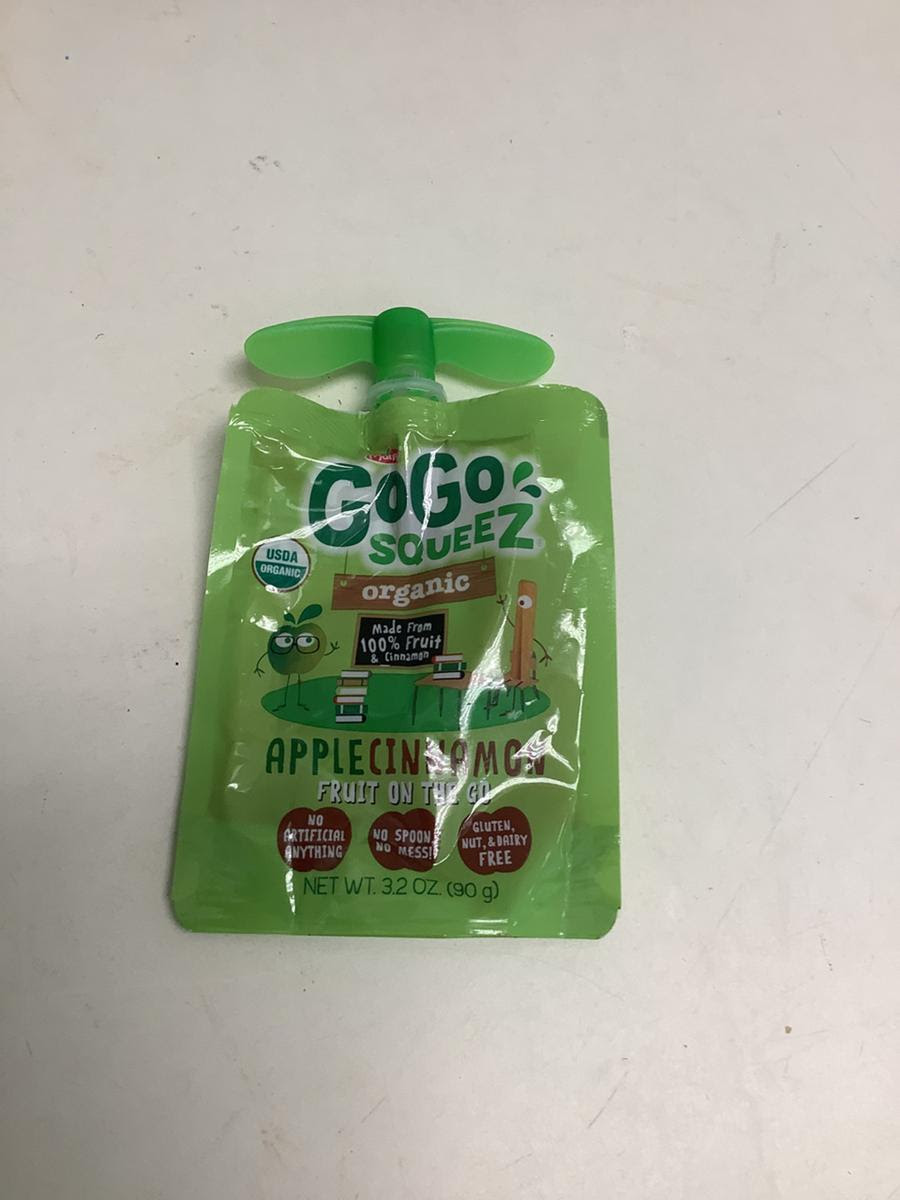
Use This! Not That!


USE THIS...NOT THAT!

USE THIS!


Young children are working hard on hand eye coordination and using utensils with proper manners. Eating from a cup or bowl with a spoon provides a multitude of benefits. 


Pouches are certainly easy, but do not provides any skills for the child. Save these for road trip snacks.


NOT THAT!

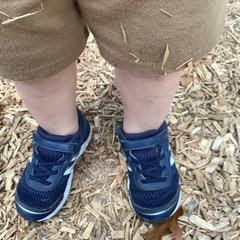
USE THIS!


Young children play hard outside running and climbing, and  sturdy, fastened shoes are a must to enable us to play like we need to. Plus, they get really annoyed when mulch or gravel gets into our open shoes. It cuts down on their playtime getting mulch out!


Sandals and croc-type shoes are easy to slip on and off, but are best left to the beaches (croc-type shoes are perfectly servicable for indoor slippers).


NOT THAT!


USE THIS!


You can use absorbent pads on furniture in case of accidents, this allows children to feel wet and understand when they should have gone to the bathroom. These are also a great choice for the car rides to and from school.


Pull-ups do not allow children to feel wet, and teaches them to ignore their body's signals. It is also confusing to a child that sometimes when they release they feel wet, and other times they do not. Save pull-ups for nighttime sleep, which requires the hormone ADH (antidiurectic hormone) to be fully developed in order to wake up dry. 


NOT THAT!


Sunday, January 26, 2020

Young Infant "Toys"


Reposted from my Moonlight Blog: March 30, 2017
Hi Tammy!
I’m looking for some recommendations from a Montessori perspective of fun activities and play time to do with an infant. She is 6 weeks old and I want to keep her appropriately stimulated (not over or under stimulated) with things that her brain can actually process at this age and the coming weeks. Do you have any tips?
Hello!

For six week old, a generally recommend a soft, but firm place to lay on her back and observe. A futon mattress works well. I like to place it in a place where she can have one nice view (like where she could see out a bank of windows to outside), and if she turned her head the other way it is a blank wall. This will provide her with a self-selected break if she chooses. 

In the first 3 months we use the mobile series. I have linked to the DIY versions (thank you, to Rachael at Little Red Farm and Meg from Sew Liberated). You can also buy either assembled or unassembled versions on Etsy. They are not very commercially available, we make them in teacher training.
The Visual Mobile Series (these are used for baby to look at, and should always be kept out of reach):

Visual Mobiles

Munari Mobile (3-6 weeks)
Octahedron Mobile (5-8 weeks)
The Gobbi mobile (7-10 weeks)
Dancers Mobile (8-12 weeks)
Flowing Rhythm Mobile (8-12 weeks)
Butterflies (10-16 weeks)
Hummingbirds (10-16 weeks)
Mother and baby whales (10-16 weeks)

Tactile Mobiles

The Tactile Mobile Series
Tripod mobile hanger (can be used with or without mat, also available to purchase)
Bell on a Ribbon (12-16 weeks)
Wooden ring on elastic  (12-16 weeks)
Primary colours mobile (12-18 weeks)
Wooden musical mobile (16-20 weeks)
Then I also use a tented cloth on her side (the side that is more “stimulating”). She can reach for it and eventually work on grabbing it. That is basically a cloth of firmish material (a washcloth works) that you pull up in the center so it looks like pyramid).
I HIGHLY recommend the book The Joyful Child, by Susan Stephenson. Her website is also a wealth of information.


Wednesday, January 8, 2020

Natural Consequences and Toddler Clean-up Expectations


Reposted from my Moonlight Blog: April 12, 2017
Question from FaceBook: How do you handle when toddlers refuse to put things away? Mine just turned two and we are trying to get her to put her toys away when she’s done with them. Sometime she does it really really well, and other times she just refuses. The natural consequence I’ve been using is that she doesn’t get to play with those toys anymore and they go away in the closet and she says bye-bye. But that doesn’t seem to be making too much of an impact. What do you guys suggest for this?
Answer: This expectation would not be developmentally appropriate. They will not begin doing this consistently until much later (in school, this is one of the signs that they are ready for the 3-6 classroom). I model cleanup, invite them to join me, but it is not an expectation. At home we would encourage families to keep the toys out to a minimum (between 9 and 12 activities). Try to not have big buckets of toys, such as giant buckets of blocks. With those toys have 10 or so pieces out only. Taking the toys away would be considered a punishment, which we try to avoid. In this situation, the natural consequence is to have a mess to look at, a toy that gets stepped on and hurts someone, or gets stepped on and broken. As I am modeling clean up, I mention these consequences as the reason I am cleaning up.
The adult keeps the order, the child internalizes it, then they begin to keep the order themselves eventually.
Q: Thanks so much for this clarification. One of the problem is that toys are indeed a big bag of blocks. She loves to dump them all out and then sort of organize them, but then it’s always a struggle to put them away. I will try giving her just 10 pieces. So in that case, does that count as one toy and then she can also have a handful of other choices? Right now we’re doing a lot of puzzles and sets of things like animals that are magnetic. So each toy has a lot of little parts. What should I do in terms of how many of those to have out at a time?

A: The group of ten counts as one one activity. For animals I keep 5 or 6 out as one activity. One puzzle is out. One or two books (and I count that in my nine). If most things have multiple pieces I try to stay closer to the 9 mark than 12.

Q: Thank you so much! It makes total sense, now that you pointed it out, that taking the toy away was not a natural consequence. That feels much better to me to just ask her to clean up and do it for her for now. We are also struggling with the obedience aspect. I know that cooperation not obedience is the goal, and I love that. But at what point does it become not OK for your child to flat out disobey you? Only in issues of safety? What do I say if she says no when I ask her to do something?

A: I actually don’t even think cooperation is a goal. It is nice when it happens, but it also isn’t a developmentally appropriate expectation at this age. Try to reframe your thinking from disobedience, to “acting in ways that are age appropriate”. They cannot really disobey at this age, they are acting in large part on impulse. Even if they “know” a rule, even can repeat it back, they often cannot help themselves from not following the rule to satisfy curiosity or another internal need. As they develop this impulse control they may start “disobeying”, but this typically happens around three or so and is another sign that they are ready to move from a toddler environment to a 3-6 environment. It shows that they are leaving the unconscious absorbent mind period and are entering the conscious absorbent mind period.
In my classroom, I stop a child from doing something that falls into the category of the four Ds.
The Four Ds
Destruction When something could be broken or pieces lost.
Disruption Such that it is truly bothering another, rather than something could potentially bother someone.
Disrespect Being unkind
Danger Being unsafe for oneself or another. I do make a distinction between safety like you might have to go to a hospital or could die , which I always stop, and minor injuries, like you could fall or pinch fingers, etc. I will often allow those types of “risky” behavior.

Saturday, January 4, 2020

The Bird Takes Flight

{Reposted from my Moonlight Blog, 8/28/2017}
Today is my son’s first day of school away from me. He is three, and I have had a classroom at our home for him for the last year and we are raising him in a Montessori home. I am not saddened by this transition, or worried that he is too young or will not be able to handle being away from me. Rather, I am excited for his future. I am excited for him to become attached to another caregiver, an adult that he can trust and learn from. I am excited for him to make friends, and I am even excited for him to have arguments with other children and the resulting lessons he will learn from those interactions. We dropped him off and then we left. We did not linger, we are not spending our time watching him through the observation windows.
The most important thing when your child starts school is TRUST. I was deliberate in my choice of his school. I researched, I visited, asked important questions about how the classrooms ran and the certifications of the teachers. I talked to past parents at the school.So now I trust that they will do what is in his best interest and in the best interest of the community of learners.
As a school owner, I have seen that families often cause unwitting stress on the school relationship. This in turn puts stress on the child and inhibits the child’s growth. The two issues I come across most often is 1) The families do not want their child to be growing up and see the child as still a baby and incapable and 2) The families do not trust that someone else will do things like they do it.
One of the primary differences between Montessori and other philosophies of education is that we start from the place that a child is inherently capable. From the time of birth the child has within him all he needs to construct himself.
“At birth, the child leaves a person- his mother’s womb- and this makes him independent of her bodily functions. The baby is next endowed with an urge, or need, to face the out world and to absorb it. We might say that he is born with the ‘psychology of world conquest’. By absorbing what he finds about him, he forms his own personality.” (The Absorbent Mind, Chapter 7, p. 88).
This child is not ours to mold into who we want him or her to be. Rather, the child MUST construct himself as he is. And to do this the child needs rich experiences.
No, no other person will care for your child like you do. Not even your partner. Part of the rich experiences a child needs are allowing other caregivers to be a part of our children’s lives. Research has shown that children do well with more than one caregiver: “In the Study of Early Child Care, when quality and type of care were controlled for along with family background, children exposed to large amounts of care were at increased risk for attachment insecurity only if their mothers were highly insensitive.” (Archives of Pediatric & Adolescent Medicine. 2007;161(7):669-676. doi:10.1001/archpedi.161.7.669. Retrieved from: http://jamanetwork.com/journals/jamapediatrics/fullarticle/570794). Throughout a child’s life they will have to learn how to deal with all sorts of people. Through our carefully chosen network of people we allow into our children’s lives, we can give our children practice in this. And there are many positives besides experiences. Try as we might, we are not impartial observers of our own children. We have biases, both positive and negative, that can blind us to some of the realities of our children. We need outside sources to push past these biases to allow our child to reach their full potential. As parents, we have strengths and weaknesses that affect how and what we can teach our children. Having a bigger variety of caregivers will allow our children to capitalize on other adults’ knowledge and experiences.
So fly my little bird. The sky is the limit for you and I am so excited to be a witness to your journey.

Friday, October 18, 2019

Last week was...interesting...

Our new cleaning fish rocks work!
My assistant was out last week due to a stomach bug. I was fine by myself during the class because we only have seven students, which is within Ohio's ratio rules for one teacher. At lunchtime, a substitute/floater teacher came in to relieve me (I leave at 12:15 to pick my son up from his school). I get a text in the evening, "What do I do if egg shells get in the fish tank?" Apparently, while she was helping a student in the bathroom, another student decided to test the boundaries, and take fistfuls of crushed eggshells from our eggshell crushing work. Then the next morning while I was netting the rocks and eggshells out of the fish tank with some students the egg shells went down the toilet (then later a pair of socks) by the same student. The student walked quickly to the bathroom, and it looked as it he was clenching his cheeks because he really had to go to the bathroom. I thought very little of it because he it toileting independently. But then I heard laughter from the bathroom. So, I went to check and sure enough, the student had put a fistful of shells in the toilet, as well  As a result, the students responsible for the toilet today were not permitted to walk freely in the classroom for the remainder of work period, I brought them works they requested to the table. Then they worked on picking up the egg shells that were on the floor. The egg shell work is being removed from the classroom (hopefully after this testing phase is over we can add it back, because the ultimate goal is to make chalk with the egg shells). In addition, tomorrow the rocks from the aquarium will be dry and the students that were dumping the egg shells in the aquarium will spend tomorrow removing the shells from the rocks so we can put the rocks back in the aquarium. Another new rule will be that they may not close the bathroom door for privacy. They had been trustworthy up to this point in the bathroom, but with the bathroom experiments today we’ll put another layer of security on this. This is a great teachable moment. Our rules exist for a reason (to keep the fish safe, to not break the toilet) and to break those rules have consequences that aren’t fun. Breathe...

Monday, January 28, 2019

My Monthly Art Gallery

Haddon Sundblom, "Fireside Santa", 1930s

One of the differences between Montessori and traditional preschool is how we decorate the classroom. We do not use posters, alphabets, etc. The beauty and simplicity of the classroom is one of our hallmarks. It allows the focus to stay on the materials and the children.

For my classroom, I also try make the decor in the classroom meaningful, a reflection of what the children are seeing in the world around them, as well as a way to introduce art and famous artists. In my Montessori training I remember a story about a child looking at a famous painting with Dr. Montessori. Dr. Montessori was looking at it as most adults do, but the child saw minute, seemingly insignificant, details (a mouse in the corner) because they looked at it with different eyes.

Admittedly, this is a new area for me, as I am not well versed in the area of art and art appreciation. So, I am constantly learning. And I look forward to being able to offer my students other art outside of paintings. But I am starting where I know a little (December was my first month of trying this art gallery).

December Art Gallery

I am starting with the painting above, as it was the students' favorite in the gallery this month. Really, the only one that they took notice of. This is the Coca Cola Santa, created in the 1930s that everyone has adopted as the look of Santa (red coat and hat, rosy cheeks, etc). Sundblom said he based the look on the 1823 poem "A Visit From Saint Nicholas" (what we now call "'Twas the Night Before Christmas"), and used his neighbor, a postal worker, as the model. The children definitely noticed his shoes were off and all of their questions had to do with that.


"The Christmas Tree", Alexei Mikhailovich, 1910

"Santa with Elves", Norman Rockwell, 1922

"Christmas in the Brothel", Edvard Munch, 1903-4 

"Christmas Night (The Blessing of the Oxen)", Paul Gauguin, 1902-3

"Adoration of the Shepherds", Caravaggio, 1609

"The Adoration of the Magi", Leonardo da Vinci, 1481

"The Mystical Nativity", Sandro Botticelli, 1500

January Art Gallery

Interestingly, many of the pieces in January have similar names and are from a similar time period. Apparently, the Northern Hemisphere was under a deep freeze at that time, they called it a mini-ice age.

"Winter Landscape", Wassily Kandinsky, 1909

"The Magpie", Claude Monet, 1868-9

"Landscape in the Snow", Vincent Van Gogh, 1888

"Drum Bridge and Setting Sun Hill at Meguro", Utagawa or Ando Hiroshige, 1857

"Snowy Landscape", Pierre Auguste Renoir, 1875

"Hunters in the Snow", Pieter Bruegel the Elder, 1565

"Winter", Caspar David Friedrich, 1811

"Winter Landscape", Grandma Moses, 1940s


Friday, January 18, 2019

Kintsugi, Wait! You Let Toddlers Use Glass!?


Yes. We use glass and ceramic in a toddler, even in an infant, community. And there are several reasons, the aesthetics, the real material (glass and ceramic are closer to a natural state), and it is breakable. What? Breakable materials in a community of young children? Isn't that unsafe? Honestly, it depends on your definition of unsafe. They could break a material and get cut on it. This is true. However, they are being closely supervised, and any cut would, worst case scenario, require stitches. On the other hand, to not learn how to carefully handle items causes long term unsafe habits. Adults seem to think that at some point children will just be mature and careful enough to use breakables. The reality is, and this is born out in the research, children just do not learn how to properly handle these materials. Therefore their ability to handle these items is severely stunted, leading to more dangerous injuries because adults assume competence based on age and provide less supervision.

We had one of those breaks yesterday in class. A child aged 2 year and 10 months dropped a glass tray 
and it broke. 


We swept the glass, with a broom then a vacuum, and made sure that everyone was wearing their hard soled slippers. We saw that there were three large pieces that were potentially repairable. So, I saw an opportunity for two lessons. One in repairing a broken item, rather than simply throwing it away. The second was something I learned on social media, a technique used in Japan to repair broken ceramics called Kintsugi. where the break is repaired with gold and becomes part of the life story of the item. While our classroom budget does not allow for the purchase of gold, it does allow for the purchase of gold acrylic paint and a small tube of super glue. We first painted the broken edges with the gold paint, then I applied super glue and held the pieces together. It seemed to work! On Monday we will return this to its place on the shelf, with an addition to its life story.

For more information on Kintsugi: https://mymodernmet.com/kintsugi-kintsukuroi/


Saturday, January 12, 2019

A New Adventure/ My December Classroom

Happy New Year!

Something popped into my life at the end of November that fit in easily, and has been thoroughly fulfilling. A local Montessori school had their toddler lead guide leave with a family emergency, and they needed a fill in. They were able to accommodate my son's school schedule, and his school was able to allow him to stay for lunch so that I could be there for the children's entire work cycle. I began at the beginning of December, and made many changes to the environment, and the students adapted beautifully. A month in and new habits are being nicely engrained: spills are regularly being cleaned up, they get their placements out before snack, put their dishes in the bin after snack, and switch to slippers when they arrive.

Here's a look into our December classroom:


As you enter the classroom to your left you will find a shoe shelf and chair to sit in while putting on and taking off shoes and slippers. On the shelf is a shoe horn for those difficult shoes. Next to that is the care of the the environment shelf and the sensory table. At the sensory table for December we were washing a baby.

Left-to-right on the top shelf (too high for student's to reach), is a candle that spins with the heat of the flame, facing towards the parent observation window is three resources for families to check out: "The Joyful Child" by Susan Stephenson, the NAMTA DVD "What is the Montessori Toddler Community?", and "How to Raise an Amazing Child" by Tim Seldin, and and LED candle.


On the care of the environment shelf is (left-to-right):

Top: "I Can Help" book, plant, watering can
Middle: small broom and dustpan, duster, table washing work
Bottom: flower arranging, hammering tees


Next while walking to the left is a ball tracker. This work has four balls: red, blue, yellow, and green. I took the photo while a student was chasing down the errant three balls :-).


Then we will come to the wagon with jugs to place in and pull around. NOTE: I use thick juice jugs rather than milk jugs. They split less easily when dropped.


Next we come to dropping bells into a jug. The younger members of our community can use a palmar grasp, the older members can use the string on the bell ornaments to drop with a thumb-forefinger grasp.


Next we come to drawing on the window with a window crayon and then washing the crayon off of the window. In the caddy is a squeegee, a spray bottle, and a microfiber cloth.

When we turn we come to our art easel. We are currently using a paint brush and long green construction paper (12 x 18) with red paint to make wrapping paper. I only put about half an inch of paint in the cup each morning and refill as necessary during the work cycle. After the work cycle I clean the cup out. To hang the paper I attached a magnet strip to the easel and I use washers. This is easier than clips for the toddlers.


The other side of the art easel is a chalk work. Red and green chalk and a sprayer and sponge to clean (the cleaning is more popular than the drawing!). You can also see our Rainbow Rocker behind the easel.


Beside our window washing is our art and music shelf (left-to-right):

Top: drying rack, Christmas cactus
Middle: dough work, holiday card making (see below for close-ups of both)
Bottom: Jingle Bells book and bells, drum with drumsticks


Both of these art works are open ended. While I make have a goal in my mind, I do not create a model for the children to follow. I also do not tell them it is a gift for their family. I let them create, then I saved it if they wanted to. Not all students made one and it is not required of them.


A wreath ornament from my youngest (19 months old), and my oldest (will be three at the beginning of March). The dough used is Model Magic.


Wrapped and finished gifts with holiday cards attached.

Continuing on around the classroom, this is our Peace/Self-Reflection Corner (left-to-right):

Top: meditation jar, desktop fountain (which has been great for learning self-control and how to watch something with hands behind back and not touch), and lavender filled stuffed frog

Bottom: "Guess How Much I Love You" book and stuffed animal


Next stop the beloved fish tank. Another classroom addition that has been great for teaching self-control and care of living things. Five 25 cent feeder goldfish are in here, saved from being another animal's next meal!


On the science shelf is (left-to-right):

Top: fish feeding, "Let's Have a Pet" book, Golden Pothos cutting, fish book and a stuffed fish for naming parts of the fish
Middle: "Wet Pet, Dry Pet, Your Pet, My Pet" book, fish in water, gluing parts of fish
Bottom: rock exploration (geology), fizzy water (chemistry), Juniper branch (berries removed and placed in a salt shaker for smelling) and pine cones (life science)


Next we come to our calendar. The ornaments we are adding to our tree mimic the bead bars in the casa classrooms. This is an indirect lesson, we are only counting number of days in the month, not each line. We do not have a circle or calendar time, this is a first come first served work and members can also take it apart and reapply as much as they would like.


On the language and math shelf is (left-to-right)

Top: "How the Grinch Stole Christmas" book and stuffed animal (it was being loved when the photo was taken), plant, "Twas the Night Before Christmas" book
Middle: matching photos and objects, Frosty the Snowman (see below for details)
Bottom: ornament for calendar, goldfish matching and sorting (using colored Pepperidge Farm goldfish crackers), matching photos and shapes


matching photos and objects
Frosty the Snowman
matching photos and shapes


Continuing on, is our cooking station. Depending on what is on the menu, we will use a crockpot, fifth burner,or toaster oven. This month we made wassail and hot chocolate in the crockpot.


Our dishwashing stand and laundry hamper below.


Our broom, sweeping guide, and mop for caring for our community. These are in almost constant use!


On the care of the self shelf is (left-to-right):

Top: box with bangles, tissue box, plant
Middle: velcro frame, large button frame
Bottom: brushing teeth, dressing a baby (see below)


brushing teeth
dressing baby


On the care of the environment food prep shelf is (left-to-right):

Top: compost crock, placemats, napkins and silverware
Middle: pouring water, snack item 1
Bottom: snack item 2, making a pomander, bean pouring

Our snack changes daily and we put out the necessary prep and serving materials.


Plates and glasses for snack.
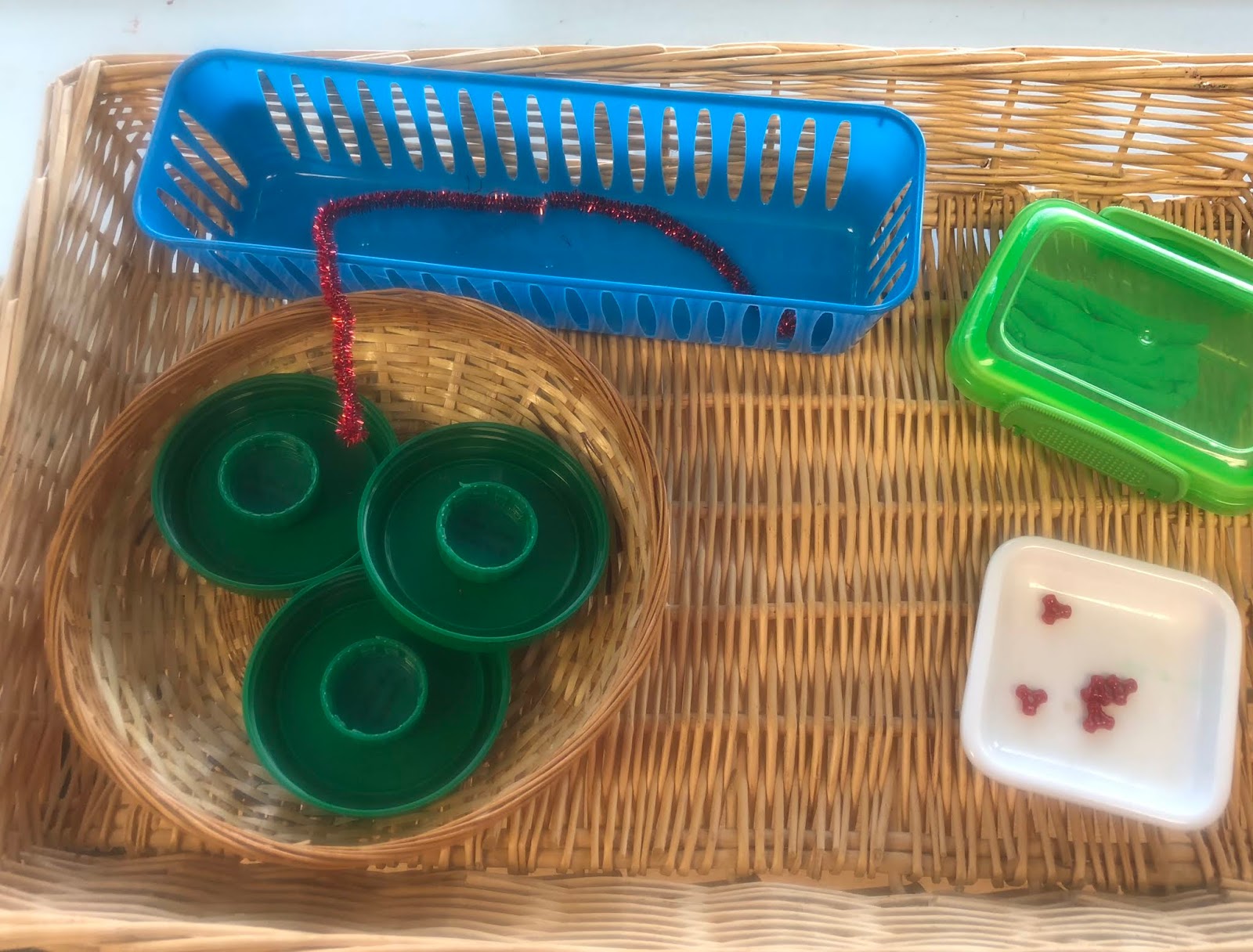


On the sensorimotor shelf is (left-to-right):

Top: rainbow stacker, table work mats, geometric grading puzzle
Middle: geometric lock boxes, disk on horizontal dowel, disk through slot
Bottom: triangle stacker, bead stringing, screw block

Floor work rugs are next to the shelf.


Tree for decorating. Underneath is a recycling bin.


And finally our cubby area.


Bathroom waiting and changing area, and of course, bathroom reading material!


Bathroom cubbies for changing clothes.